Linux is Latin
World Domination is still arriving, but it's not thanks to anybody's empire.
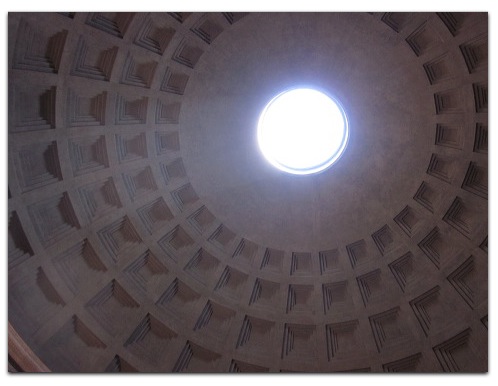 Rome — Latin isn't the first Western language; just the first to become a de facto standard. It's a standard that still exists, or I wouldn't have used "de facto" in the last sentence. Nor would I feel free to leverage latinate terms in English, which is just one of Latin's many twisted forks.
My first suspicion that Linux was Latin didn't arrive here in Rome, but in a car last week in North Carolina. I was driving up the Interstate, somewhere between Graham and Haw River, when I saw a billboard for a company that needed Linux programmers. Thus it occurred to me, on the spot, that Linux was becoming the lingua franca of big business IT development.
True, Linux isn't a language in the literal sense, but it is becoming necessary to know Linux if you are going go get along in IT, just as you needed to know Latin if you were going to get along in the Roman Empire and its sphere of influence—for a millennium and a half following the time of Caesar.
Latin was inherited by Rome and its empire from the Latins, a tribe that inhabited Latium, the fertile lands drained by Tiber along the river's south side. Latin itself was a branch of Italic, which was a branch of Proto-Indo-European, which is now used even less than Multics, which we might call Proto-Unix. And thus we arrive at Latin as a metaphor for Linux.*
For Latin, World Domination is still going on, because it is embodied in dozens of languages, as well as countless sciences, art, literature and everything else they teach in school. For Linux, World Domination still starting.
Like Latin, Linux has roots. Those are mostly in Unix, which also persists through variants such as HP/UX, AIX, Solaris and the BSDs. But Linux is now the One That Matters. It is, by far, the world's most common, easily used and free (as in both beer and speech) OS. And it didn't require an empire to arrive at that state.
In that sense it also bears another resemblance to Latin, because what remains of ancient Rome offers less evidence of empire than of engineering. Romans may not have invented everything they spread, but they did create and maintain a system of respect for invention, in the form of writing. They kept records of everything they could. While Rome did much (or all) to give us paved roads, dams, aqueducts, water-distribution systems, public baths, blown glass, cranes, elevators, stadiums and building designs and methods of many kinds, the reason was not just that an empire spread those things. Rome also needed engineers, skilled craftspeople, and a spoken and written language to communicate How Things Are Done.
My favorite example is the Pantheon, which for seventeen hundred years has held the record for the world's largest unreinforced concrete dome. Look up at the roof from inside and you see the shapes of the forms into which mixed concrete was pounded (it wasn't poured). There isn't a crack anywhere in the whole thing.
We know how the Romans made that concrete because they commented on their methods in writing. All their building methods were de-bugged, patched and improved in ways that are echoed in how we make, improve and communicate about code today. That's one reason the Roman's innovations were easily shared and spread. Having an empire helped, but that was an insufficient condition. They also needed writing and speech that everyone could understand and put to use and re-use.
I'd like to say the same about coffee, which came to the world from Ethiopia by way of Venice. By acclaim two of the best coffees you can drink are found only at Sant' Eusatacio and Tazzo d'Oro, both within a stone's throw of the Pantheon. Neither shares their secrets, which are closely guarded and highly proprietary—as once was AT&T's Unix.
I love the coffee I've enjoyed repeatedly at both places. But I can make espressos, cappuccinos and mocchiattos at home too, on my own Italian machine, using coffee roasts of all kinds. And, frankly, I like my own coffee creations just as well, if not better, than these Roman originals, especially when I get it right. Those two places may have set the original standard. But coffee, like language and code, is a living thing that nobody owns, everybody can use and anybody can improve.
I can't guess how long Linux will prove to be the same, but its age is clearly upon us.
* It's important to remember that all metaphors are wrong, or they wouldn't be metaphors. Metaphors are inexact likenesses that help us understand and communicate what we know. Literally speaking, life is not a journey, an idea is not an object, and time is not money. Yet we neither think nor talk only in literal terms. In fact, we can't. Our minds are constantly categorizing and comparing. That's why we move through life, catch ideas, and save time.