I believe the best and worst thing about Linux is its hard distinction between kernel space and user space.
Without that distinction, Linux would never have become the most leveraged operating system in the world. Today Linux has largest range of uses for the largest number of users—most of whom have no idea they are using Linux when they search for something on Google or poke at their Android phones. Even Apple stuff wouldn't be what it is (for example, using BSD in its computers) were it not for Linux's success.
Not caring about user space is a feature of Linux kernel development, not a bug. As Linus put it (on our 2003 Geek Cruise), "I only do kernel stuff... I don't know what happens outside the kernel, and I don't much care. What happens inside the kernel I care about." After Andrew Morton gave me additional schooling on the topic a couple years later (on another Geek Cruise), I wrote, "Kernel space is where the Linux species lives. User space is where Linux gets put to use, along with a lot of other natural building materials. The division between kernel space and user space is similar to the division between natural materials and stuff humans make out of those materials."
A natural outcome of this distinction, however, is for Linux folks to stay relatively small as a community while the world outside depends more on Linux every second. So, in hope that we can enlarge our number a bit, I want to point us toward two new things. One is already hot, and the other could be.
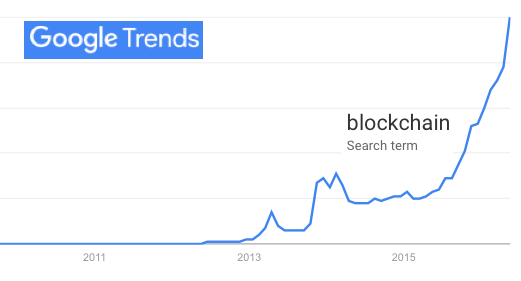
The first is blockchain, made famous as the distributed ledger used by Bitcoin, but useful for countless other purposes as well. At this writing, interest in blockchain is trending toward the vertical:
The second is self-sovereign identity. To explain
that, let me ask who and what you are.
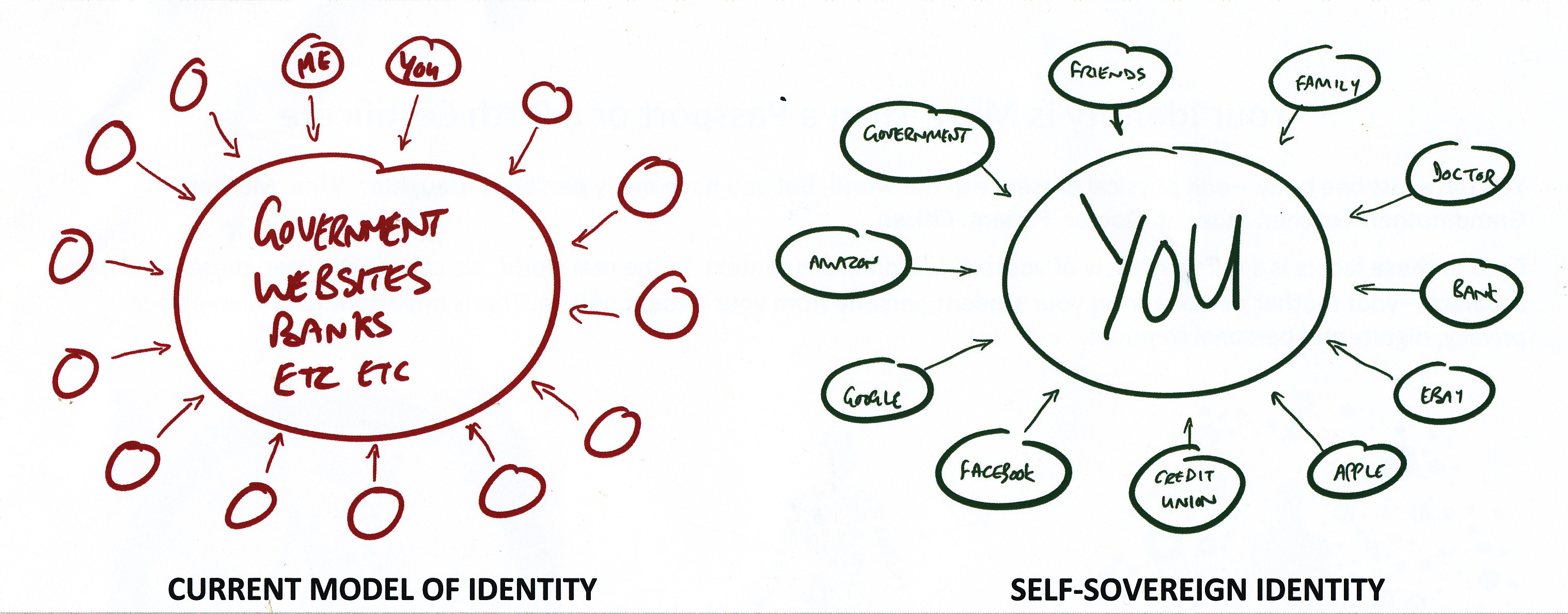
If your answers come from your employer, your doctor, the Department of Motor Vehicles, Facebook, Twitter, or Google, they are each administrative identifiers: entries in namespaces each of those organizations control, entirely for their own convenience. As Timothy Ruff of Evernym explains, "You don't exist for them. Only your identifier does." It's the dependent variable. The independent variable—the one controlling the identifier—is the organization.
If your answer comes from your self, we have a wide-open area for a new development category: one where, finally, we can be set fully free in the connected world.
The first person to explain this, far as I know, was Devon Loffreto. He wrote What
is sovereign source authority? in February, 2012, on his blog, MoxyTongue. In Self-Sovereign
Identity, published in February of this year, he writes,
Self-Sovereign Identity must emit directly from an individual human life, and not from within an administrative mechanism... self-Sovereign Identity references every individual human identity as the origin of source authority. A self-Sovereign identity produces an administrative trail of data relations that begin and resolve to individual humans. Every individual human may possess a self-Sovereign identity, and no person or abstraction of any type created may alter this innate human Right. A self-Sovereign identity is the root of all participation as a valued social being within human societies of any type
To put this in Linux terms, only the individual has root for his or
her own source identity.
In the physical world, this is a casual thing. For example, my own
portfolio of identifiers includes:
You can get a sense of how bad this is by checking the list of logins and passwords on your browser. On Firefox alone I have hundreds of these. Many are defunct (since my collection dates back to Netscape days), but I would guess that I still have working logins to hundreds of companies I need to deal with from time to time. For all of them, I'm the dependent variable. It's not the other way around. Even the term “user” testifies to the subordinate dependency that has become a primary fact of life in the connected world.
Today the only easy way to bridge namespaces is via the compromised convenience of "Login with Facebook" or "Login with Twitter." In both those cases, each of us is even less ourselves, or in any kind of personal control over how we are known (if we wish to be knowable at all) to other entities in the connected world.
What we have needed from the start are personal systems for
instantiating our sovereign selves and choosing how to both reveal and
protect ourselves when dealing with others in the connected world. For
lack of that ability, we are deep in a metastasized mess that Shoshana
Zuboff calls
'surveillance capitalism," which she says is "unimaginable outside the
inscrutable high velocity circuits of Google’s digital universe, whose
signature feature is the Internet and its successors. While the world
is riveted by the showdown between Apple and the FBI, the real truth is
that the surveillance capabilities being developed by surveillance
capitalists are the envy of every state security agency." Then she
asks, "How can we protect ourselves from its invasive power?"
I suggest self-sovereign identity. I believe it is only there that we have both safety from unwelcome surveillance and an Archimedean place to stand in the world. From that place, we can assert full agency in our dealings with others in society, politics and business.
I came to this provisional conclusion during ID2020,
a gathering at the UN on May. It was gratifying to see Devon Loffreto
there, since he's the guy who got the sovereign ball rolling in 2013. Here’s
what I wrote about it at the time, with pointers to Devon’s earlier
posts (such as one sourced above). Here are three more from the field's
canon:
A one-pager from Evernym, Digi.me, iRespond and Respect Network was also circulated there, contrasting administrative identity (which it calls the "current model") with the self-sovereign one. In it is this graphic:
The platform for this is Sovrin, explained here as a "Fully open-source, attribute-based, sovereign identity graph platform on an advanced, dedicated, permissioned, distributed ledger." There's a white paper too. The code is called plenum, and it's at Github.
Here — and places like it — we can do for user space what we've done for the last quarter century for kernel space.