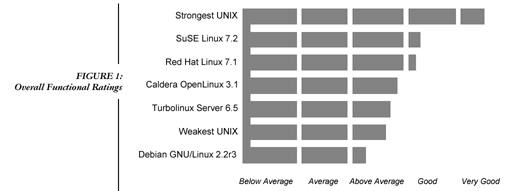
On September 25, the research firm D.H. Brown released a study that went a long way toward legitimizing Linux as a serious business platform, and not just a handy way to serve up Web pages and perform other low-level business gruntwork.
The report begins, "For the first time since D.H. Brown Associates Inc. began studying the functional capabilities of Linux-based operating systems, the strongest Linux distributions surpass the weakest UNIX systems in overall functionality. Using the version 2.4 Linux kernel has improved the features of the operating system. In addition, all of the vendors studied -- SuSE, Red Hat, Caldera, Turbolinux, and Debian GNU -- have increased the breadth and depth of their bundled network infrastructure software.
The report analyzed scalability, RAS (reliability, availability, serviceability), system management, Internet and web-application services, and directory and security services. "With these upgrades in place, the leading distributions of Linux are able to serve as general-purpose operating systems for a wide range of departmental and workgroup applications." This graphic shows how the various distributions stacked up:
In a 1999 study, D.H. Brown articulated the prevailing business wisdom about Linux at the time: "that linux was primarily suited for low-end web, file and print service, along with use in appliance servers and clustering for high-performance technical computing." Now, the company says, "the leading Linux distributions are quite capable of serving as general-purpose operating systems for a broad range of departmental and workgroup applications."
Where Linux fell short of the top UNIX systems, the report said, was in areas "such as high-end Shared Memory Multiprocessing (SMP) scalability and advanced reliability features (which) require a degree of close coordination between hardware and software designers that has not yet emerged in the Linux community." The report adds, however, that "the gap between Linux and these UNIX systems has certainly closed at a rapid pace."
For more information, visit http://dhbrown.com/dhbrown/Linux.cfm.