Apple's raises its open source stakes by basing its new browser on KHTML and turning its code back to the community. The big question: Now what?
Steve Jobs' Macworld keynotes are always Major Events in which lots of new stuff gets announced; but they rarely carry much news of unusual interest to folks the Linux side of the OS tracks. True, Apple has been talking up UNIX and open source for several years now, and its OS X-based laptops are popular Type O devices in UNIXy environments, including plenty of Linux shops and households. But hardly anybody expected Jobs to deliver any open source surprises -- least of all a new app based on a code developed by and for the Linux community.
But that's exactly what they did with Safari, Apple's new browser.
There had been rumors that Apple would replace Microsoft's Internet Explorer as the default browser in the OS X "dock". While standing in line with other "media" waiting to be herded into our special section in the keynote theater, I talked with some old-timers who rolled their eyes remembering Apple's last browser effort, the late Cyberdog. The default assumption was that Apple would add to the growing list of browsers based on Mozilla's Gecko engine, perhaps coming out with its own branded version of Chimera.
But that didn't happen. Instead Apple did something far more radical: They based their new browser on KHTML, from KDE.
Here's how Jobs put it in his keynote:
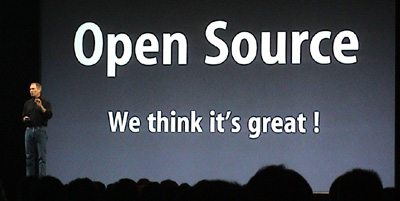
"How did we do this? We based Safari on an html rendering engine that is open source. About half the code in Safari is this open source rendering engine. Now, we started working with this over a year ago. And it needed a lot of improvement. We've dramatically improved the performance. Some things are up to an order of magnitude faster. And, some people have a problem with open source. We think it's great... (applause)... and, we are going to be putting all of our improvements to this code base -- we're going to be hosting them on the Web today. (Applause.)
The code base that we decided to start with was KHTML. It's very popular in the Linux world. And it was a very well architected HTML rendering engine that is now dramatically improved... We have built an incredible browser around it. We could not be happier with it.
Avie Tevanian, Apple's development chief, told me this:
"We looked at all the different potential code bases to build a browser on, including building one completeley from scratch. And what we discovered was that KHTML gave us the best set of trade-offs between speed, size, quality, ability to render the most sites, things like that. It wasn't always the best at all of these, but for some things it excelled, and we thought we could take our resources and add to it, to make it the best in all these aspects. We'll keep contributing changes, and we expect others will contribute changes back."
KDE's news page added this:
The KDE connection: "[f]or its Web page rendering engine, Safari draws on software from the Konqueror open source project. Weighing in at less than one tenth the size of another open source renderer, Konqueror helps Safari stay lean and responsive." The good news for Konqueror: Apple, which said that it will be "a good open source citizen [and] share[] its enhancements with the Konqueror open source community ", has today sent all changes, along with a detailed changelog, to the KHTML developers. Congratulations to the KHTML developers for this recognition of their outstanding efforts... Hat's off to collaboration!
Those developers got the news by this email to Dirk Mueller from Don Melton of the Safari development team.:
Later that day, this email came back from Don Melton:
On the floor of the show, I followed one of the Safari developers (I think it was Melton) as a guest on David Lawrence's Online Tonight radio show. Lawrence told me there had been more than 300,000 downloads of Safari on the first day. It was clearly a hot product, but not just because it came from Apple instead of Microsoft. It was a hot performer too.
Everybody I talked to at the show about the browser remarked on its speed, which seems especially swift next to the notoriously tubby Mac versions of Internet Explorer.
Glenn Fleishman, the wireless guru whose Practical Macintosh column runs in the Seattle Times, told me he had heard reports that Microsoft put countless development hours into optimizing IE for Windows, but never did the same for its Mac versions. With Safari, he said, "Apple put to use the thousands of developer hours that went into KHTML, and put in thousands more of their own, all toward solving the rendering problem." The clear implication: browser leadership has passed not to Apple, but to the open source development community, where it has belonged all along. He added, "I'm not sure why Mozilla and Gecko didn't do it," he added, "but it's happened with KHTML."
It's hard to avoid the sense that Apple's choice of KHTML was a slight to Mozilla, especially given the fact that so many keymembers of the Safari team are Mozilla veterans.
While that's an interesting gossip topic, there are bigger issues, such as the challenges Apple faces in its relationships with the open source community. James Davidson (author of Learning Cocoa with Objective C and the original author of Apache Ant and Apache Tomcat) said, "Using KHTML in the browser raises the bar on Apple's open source commitments. It's a love fest right now, but how they do it from here on out will reallly raise the bar. This isn't like Darwin, which was kind of quiet and not highly exposed. This is much more out in the open. I mean, here's this thing staring millions of users in the face that Apple is calling open source. Users will associate this browser with open source, and expect bug reports to go through an open source process. The press will be asking better questions too." (Safari has a bug report button in its title bar.)
He also wondered how community involvement would jibe with Apple's notoriously secretive development culture. "They love surprises, but that's not how open source works. I'm sure this wa the last surprise we'll see on this project. From now on, everything has to be in the open." He added, "The litmus test there will be how close KHTML and Moz will come on standards support. If they come close, that will throw the ball to Microsoft. Then we'll see whether they play nasty again with IE."
But that's just Apple's issue. The larger issue for everybody is standards. Among the geeks I talked to at the show there was complete agreement that Safari's open source code base created a new de facto condition that favors de jure standards. One Apple engineer explained, "Until Tuesday, the de facto standard was IE. That's what developers cared about, and that's what webmasters cared about. Not any more. Now everybody's going to be holding every browser's feet to the standards fire. If you fork the standards, you fork yourself." Adds James Davidson, "It's no longer game-over for Web standards interoperability. You'd better adhere to standards now."
Safari is far from a finished work. In spite of its 1.0 version number, it's still in beta. It's getting a proper pounding, too -- not only on various lists, but in geek weblogs too. Mark Pilgrim, for example, posted a buglist-filled review that brought frank and useful responses by Apple's Dave Hyatt on his weblog.
There doesn't seem to be any interference by Apple's PR apparatus. This shouldn't be a surprise. Apple engineers and PR people have been telling me for more than two years that they are very careful not to interfere with the company's open source community involvement, preferring to "let nature take its course."
We'll see where it goes.