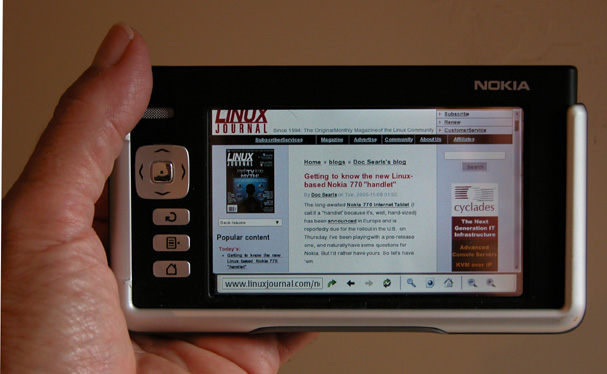
A first look at the Nokia 770
_________________________________________________
In November the long-awaited Nokia 770 hit the stores, first in Europe and then in the U.S., where it promptly sold out, at a retail price of $350. When we posted a mini-review of a pre-release unit on the Linux Journal site, we quickly got dozens of comments.
Many of us have been wondering what device would fill the empty shoes of the late Sharp Zaurus. Well, I've had a pre-release 770 since early October, and it's clear that this baby busts out of those shoes, right at the starting gate.
The 770 is a radical departure for Nokia, mostly because it isn't a phone. Instead it's a palm-sized tablet PC running on Linux (rather than the Symbian OS, which one finds in prior Nokia multimedia devices). Specifically, the 770 appears to be a browser surrounded by handy hardware and software buttons.
Its small size (5.5" x 3.1" x 0.7") and crisp 4.3" (800 x 480) 16-it color screen means that it crams a lot of detail in an area that all but requires easy zooming. For that the 770 provides both soft and hard buttons. Another hard button zooms the browser window to full screen. You can enter text (typically, URLs) with a stylus on the virtual keyboard or in hand-written letters that the 770 recognizes easily. You can also connect self-powered devices via bluetooth or USB. It has no hard drive, though you can attach one.
The easiest way to connect to the Net is through WiFi. The 770 tells you the names, signal strengths and open/locked (WEP'd) statuses of each signal, and makes it easy to override whatever choices the 770 makes on its own. It also supports WPA encryption (thanks, we are told, to Samuel Ortiz, a Linux kernel engineer who works for Nokia).
One fun feature is the 770's readiness to perform as an Internet radio. Many Web-based radio stations (e.g. RadioParadise.com, KCRW.com, SmoothJazz.com, WEMU.org, WNYC.org and WUNC.org) publish their streams' IP addresses as page links. Clicking on the .mp3 stream links brings up a player that pumps out excellent audio through a standard 3.5mm stereo plug port, for headphones or connection to an audio system.
The 770's cpu is a ~220Mhz OMAP 1710 powered by an ARM9 core. Memory is 64Mb DDR RAM, expandable through an RS-MMC (Reduced Size MultiMediCard), or through full-size SD cards.
We are told that the base distro is Debian, running on the 2.6 kernel, and the desktop is based on Gnome (no word from Nokia directly on those questions, at this writing). Nokia's development platform for the device is maemo. Go to maemo.org to find out more.
Applications are sure to pile up quickly. (An X terminal emulator is already at 770.fs-security.com/xterm/.) Base apps include the Opera browser, v6 Flash player, an email client, the Internet radio, a news reader, audio and video players, image viewer, PDF viewer and file manager, among other things. The audio decodes nearly all formats other than Windows Media and (so far) ogg. Same with video.
Given the interest we've seen so far from both Nokia and the 770's new development community, there is much to feel encouraged about. Here's hoping it's the first member of a growing family -- as well as a pioneer in a new marketplace.
- Doc Searls
[Note: Here's a directory of images. If we need me to shoot more, let me know and give me directions.]