
My friend Michael is a botanist, a founding figure in Santa Barbara County's wine industry, and has been observer of wildfires since he helped fight the including the Coyote Fire and evacuate residents from its path. In 1990 his own home was spared destruction by the Painted Cave fire, when a change in the sea breeze stopped the flames. Between those experiential bookends he also witnessed the Romero Fire of 1971, the Sycamore Fire of 1977, and the Wheeler Fire of 1985.
So he knew what it meant two Saturdays ago, when he saw dense brown smoke coming from what appeared to be Mission Canyon. Within five minutes he saw ash raining on the beach. Naturally, he turned on the radio. There was nothing. Not on the local news station. Not the local talk stations. Not any of the music, sports, Spanish and religious stations that pack the rest of the dial. He checked on local TV, and found nothing there. He got on the Web, checked with the Santa Barbara City and County fire departments, and InciWeb, which is the Official Source for wildfire information. There was nothing on any of them.
So he got in his car and drove up to Mission Canyon. "I did not stop at the Fire station in Mission canyon", he told me, "but saw all of the persons gathered there. The security person at the Botanic Garden had a police scanner which reported, in most in-explicit scannerese, that there was fire activity near Paradise. From the Garden it was clear, at least, that the fire was not in lower Mission Canyon. Nothing else was clear.
Paradise is the name of the valley on the far side of the Santa Ynez Mountains — a ridge of wooded sandstone forms the picturesque background for the Santa Barbara. By air Paradise Valley is only about four miles from Mission Canyon.
The fire was named Rancho, and we lucked out with it. The site was on the north side of the Santa Ynez river, where it was contained within two days and put out within five. While it only burned a few hundred acres, it still took hundreds of fire fighting personnel working with hand tools, tractors and air tankers, to put it out.
What would have happened if the fire had started on the south side of the river? If winds pressed it up the slope and toward Santa Barbara, it would have been almost impossible to contain short of the ridge line — if it could have been stopped at all.
That's because wildfires don't just spread along the ground. Moving through thick "fuel" (that's what they call dry vegetation, including the wood in your house), they are volcanos that launch burning debris hundreds of feet into the air, and shower fire hundreds or thousands of feet downwind. The Painted Cave Fire started around 6:00pm near the intersection of Painted Cave Road and Highway 154. Pushed southward by strong winds, the fire quickly spread down into Santa Barbara. By 7:15pm the fire was in Tucker's Grove and Camino del Rio, and hundreds of houses were burning. By morning it had jumped Highway 101 and advancing toward the sea.
Bear in mind that a freeway like 101 is considered a firebreak. But the biggest fires can easily leap highways, or even lakes. The Oakland fire of 1991 spread from Hiller Highlands to the Piedmont section of Oakland by leaping over highways 24 and 13, plus Lake Temescal. More than three thousand homes burned in that fire. The neighborhoods burned looked very much like those of the Riviera, Mission Canyon and other hilly parts of Santa Barbara.
The Painted Cave Fire spread across 101 and all the way to the south side of Modoc Road before it was turned back by shifting winds. It burned 641 structures. The Sycamore Fire took out 234 structures from Rivera east across Barker Pass. The Coyote Fire destroyed mansions in Montecito, artist enclaves along Mountain Road, and then and advanced up the slope, burned across the Santa Ynez Mountains and Paradise Valley on its way back into the San Rafael Wilderness. The mountains were turned black as more than 40,000 acres were consumed. The Romero Fire burned nearly everything north of East Valley Road in Montecito. According to the Montecito Fire Department, 1,042 structures were burned in those four fires. Twelve lives were lost, eleven of them firefighters.
Here is the Montecito Fire Department's burn map for large fires since 1960:
Here's how Sycamore Canyon looked, after the fire in 1977. See how large an area that covered. Then look back at the burn map to get some perspective on how large the burn perimeters can get.
Winds were low near the Rancho Fire when it started: only about 3 miles per hour. But up at the ridge winds were much higher. From my vantage at a ranch about 10 miles west I could see smoke billow upward like a mushroom cloud, then hit southbound winds at about 3000 feet — the rough height of the ridge itself. From there the smoke unfurled like a banner, straight across Santa Barbara. Here is one photo in the series I shot from that ranch:
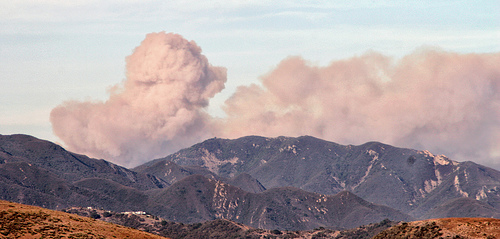
That shot was taken at about 6:30pm. The fire was first reported about an hour earlier. By 9:00pm, the wind where I stood taking those pictures had reached near-gale force, straight out of the North. Fortunately, the fire was contained by then.
But what about next time? How soon will that be?
Well, we have had eight major fires since 1955, and that doesn't count the Rancho Fire last week, the Day Fire that burned through the Sespe Wilderness during all of last September, the Zaca Fire going on now (in Santa Barbara County) or any number of smaller fires we were lucky didn't make bigger news. The seventeen years that have passed since Painted Cave is a modern record. This year is one of the driest ever. We are more than overdue for another Big One.
So, Michael asked over dinner, What can we do to fix the radio problem? He directed the question at me, pointedly, because I had brought up that subject twice in the last few months, in blog posts titled Let's bring local public radio to Santa Barbara and Local Radio Chessboard. He believes — as do I — that radio is the only practical way to keep the largest number of citizens informed in the event of a fire. Since commercial radio can't find a way to keep the public informed on a live up-to-the-minute basis, the only choice facing the public is to create a station of their own.
As it happens (and as I explained in those two last links), there is a fortunate combination of opportunities in front of us right now. Here they are:
So I'd like to gauge people's interest in putting a station on the air. You can write me (doc AT searls dot com) or post your comments below. Meanwhile I'll be talking to some of the organizations listed above — including meeting later this month with the Public Radio Capital folks. I'd like to go into that meeting with encouraging news. Regardless of whatever course we take, it would be good to have their guidance.
By the way, I've posted this here at IT Garage for three reasons: 1) because it's about DIY (do it yourself) technology work, which we'll need in order to make this project happen; 2) it's a sturdy site with a nice comment system; and 3) I've been neglecting it and want to stop doing that.
To answer additional questions about this project and why it's a good idea, here's a Q&A. I'll enlarge and update it as dialog moves forward.
Which won't happen, of course, unless there is a groundswell of interest in the project. So consider this an appeal for news coverage and dialog involving — in alphabetical order —
See you here. And there. And, if all goes well, on the air.