I don't want to join my 'local station' I don't want to 'support PBS Kids' I want to give to FRONTLINE - Period. (Well maybe like 10-15% could go to some general fund but other then that just Frontline).She writes in the second person voice because this post began as an email she sent to me. I told her to post it so I could point to it.If you (Doc) can fix this you will make them money. Until then I don't give.
Her point and mine: Public broadcasters need to face the fact that some paying viewers and listeners want to "go direct". That is, they want to support programs and producers, and not just stations. This is especially the case when they're listening to those programs on live streams or from files downloaded from the Net— as is the case with Kaliya. She explains,
I don't own a television and have not watched in that format since I went to college in '95. Online viewing is the only way I see shows. I know it costs money to give me this experience and I am willing to donate to keep it up and running for open public viewing (I will not pay if you charge me to watch it though).Dave Winer has a similar orientation as a customer of public radio. Here's what he wrote about that a few months ago:
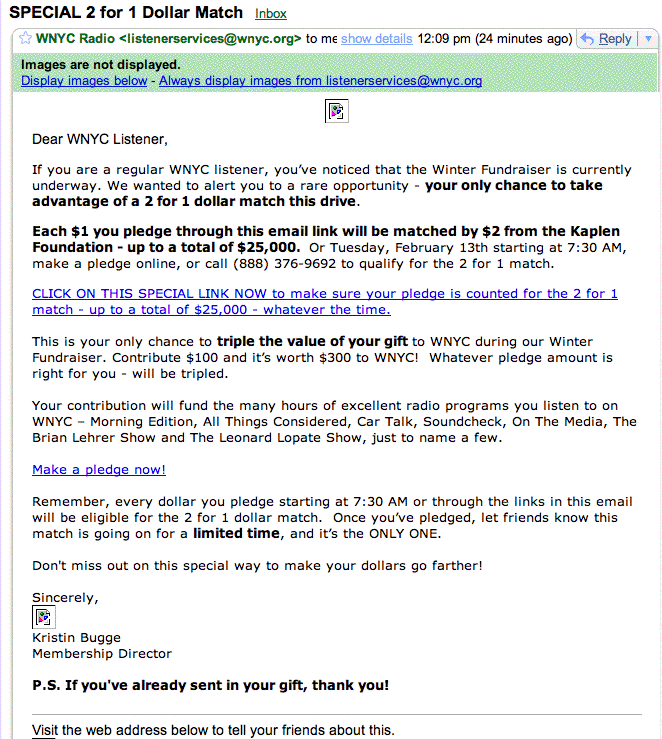
9 times out of 10, I don't give money to public radio stations, because once you do, you never hear the end of it.This is what in business we call a channel conflict. We're talking about retail channels here, not broadcast channels; although the conflict between those two meanings is close to home as well. Until the Net came along, the only place you could get radio and TV programming was on radio and TV. Once the Net came along, distribution over that medium conflicted with broadcast. That is, listeners and viewers could now "go direct" over Net connections, either to a live stream or to an archived program in the form of a video download or a podcast.A few weeks ago, in response to a request for support from On The Media podcast, I gave $100 to WNYC. I don't even live in NY. Now I'm getting a steady stream of spam from them with all kinds of special offers. This really sucks.
Of course public broadcasting folks know this. That's why they call their field "public media" now. It's also why they've altered their pitches to suit the medium; but only up to the point where the old business model crashes into the new one. At that point they stick with the old.
That is, they'll start a live stream with, say "WBUR's Web streams are made possible by IFAW, the International Fund for Animal Welfare..." or "WNYC's Web streams are supported by the New York Botanical Garden..." or "Hi.... Because you enjoy listening to WGBH online, consider making a contribution..." Or they'll start a podcast with, "This is Terry Gross, the host of Fresh Air. You're listening to our podcast. Our program would not exist without our listeners who support their local public radio stations, so we want to start by saying thanks", followed by an announcer saying "Support for NPR podcasts comes from Master Card..."
Two things are going on here.