Wireless Paradise Lost
 Wireless Internet has gone to hell. Sure, 802.11 (Wi-Fi) has improved technically, and there's more 3G activity than ever, but the paranoids and control freaks have won. If you want to get on the Net over Wi-Fi or cellular data connections, you're mostly living in their world.
Today's new Wi-Fi access points are "secure" by default, and avialable connections outside your house are mostly those of commercial entities that operate on a pay toilet business model. The main difference is that pay toilets generally don't close the seat after a time limit or force you to accept terms of use.
Meanwhile 3G has been FUBAR from the start, because it was created by phone companies, which live to herd users through toll-filled mazes, and whose promotional and business practices are protected by long-since-captured regulators. Thus 3G "service" is thick with user-hostile absurdities, and contained within national boundaries beyond which customers risk losing copious amounts of money on "roaming" and other charges.
Two Genesis stories of the free and open Internet show how close we've come from that Eden.
The first was a London adventure in June 2002. I was on my way back from a Jabber (XMPP) conference in Munich, and had a weekend to kill in Kensington. Near my hotel I spotted a small Internet cafe, where I paid £2 for enough time to discover Consume.net, which was like an OpenStreetmap for free hot spots all over London, complete with maps and details about each one. All were offered as public graces by individuals sharing their Internet connections — a practice Nicholas Negroponte at the time compared to putting out flower boxes. It was maintaned by a mix of geeks and civilians, and the sense of community was high.
Guided by a Consume.net map, I walked only a few hundred yards to a little sidestreet called Kynance Mews, where I sat outside a French bakery enjoying some coffee and free wi-fi from an access point hanging from a window across the street. After a few minutes passed, a tall familiar-looking chap came along, walking his great dane, and chatting about free wi-fi with another customer. When I asked him if this was his node, he said "You're Doc Searls! I'm Ben Hammersly!" It was a Casablanca-grade moment of Xtreme coincidence (blogged here, over Ben's node), followed by an evening in Soho at a perfect bar called Garlic & Shots, at which I met a number of other local notables that still populate various lists in my portfolio of social networks.
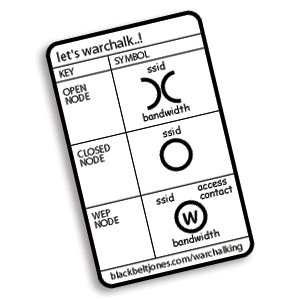
One of those notables was Matt Jones, a design guru who had just created warchalkng: a way of marking wi-fi hot spots with chalk on sidewalks. It was springtime for free Wi-Fi, and easy to roam nearly everywhere in a city like London, finding ways onto the Net, thanks to generous fellow netizens.
We decided then that covering the phenomenon would be a cool idea, so the next Spring I took a week to explore New York, visiting creative and original deployers of free Wi-Fi. The result was five pieces that ran in the XX 2003 issue of Linux Journal. Here are a few items from the list of topics I covered:
- That cafe by x part
- Ami whoosis boom box
- XXXX free hot spots, XX% of the total
- broadway.net
- NYC Wireless in Bryant Park
- Debian pebble and soekris boards
- Verizon's cool move with phoe booths.
Broadway.net and NYC Wireless are still around. Bryant Park is still bathed in free Wi-Fi waves. And there are plenty of ways to hack together and customize hot spots. But the rest of the story is sad. Verizon ripped out their phone booth wi-fi system. The cafe is gone. Worst of all, the flower boxes have mostly turned to vaults. Access points now come locked by default. Open hot spots are considered a security risk by nearly everybody. And if you want to get on the net over Wi-Fi, you've got to do yoiur deal with somebody who wants to charge you money for it, and probably won't make it easy.
Since I arrived in France with a new Android Nexus One in mid-June, I've blown 75€ (about $100) trying and failing to get data to work. The boring details are here. The one piece of good news is that all I lost was what I pre-paid. It's a measure of the customer-hating venality of mobile phone carriers that the European Union has issued stiff new rules to protect users from "bill shocks" when they go over the carriers' usage limits, running up bills in the dozens of thousands of Euros with no concern or warning from the carriers themselves. (Even captured regulators have their limits.)
Punitive billing for customers' unknown (and barely documented) 3G infractions is not limited to the EU. Exactly one year ago Sprint detected a 10, 241,740,422Kb overage in my own usage, failed to tell me about it at the time, and hit me with a huge bill more than a month later. They eventually dropped the charge because it was such a steep and unexplained spike, but the hostility of The System to a loyal customer was a remarkable thing to behold.
Perspective: 3G is data on telephony, not telephony on data. The latter makes more sense technically — and I'd suggest economically as well — but mobile phone carriers are a leopard that will not change its spots, so there's not much point in holding out hope for anything that looks like real freedom.
But Wi-Fi was born free, not already captured like 3G. I still recall its early days as a kind of heaven. Two stories in particular invite revisiting.
lkjlkj
The second was a longer exploration of New York in early 2003.