The Dark at the End of the Tube
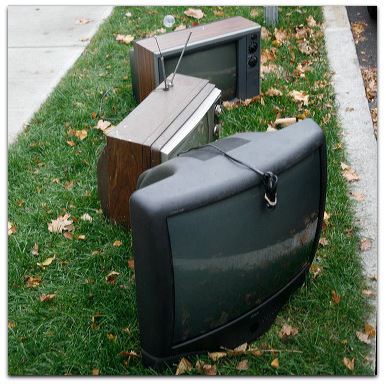 TV is falling down video's whole, like an iron statue falling into a lake of lava. But the fall is not a short or an easy one, as TV bounces and crashes its way down the slope to Oblivion. What matters most is that the end is clear: Oblivion is the Internet and TV will be subsumed by it, no matter how hard the entertainment and cable industries fight the inevitable.
When Oblivion arrives, what we now call TV will be recognized for what it is: nothing more than video streams and files, some free and some for pay. It will also be clear that these do not require a single-purpose stand-alone distribution systems.
Gone will be the need to crowd the tops of mountains and buildings with antennae, sucking millions of watts off the power grid. No more hogging of spectrum that can be used in countless other ways, all more appropriate and efficient than the regulatory carve-outs that over-the-air and cable TV have both enjoyed for a half century and more. No more one-way cable and satellite TV systems, with their with lame and proprietary set-top-boxes, all controlled totally by the supplier. When you watch your video through the straightforward UIs of Net-connected computing, equipped by a competitove market of non-captive suppliers, set top boxes will be as obsolete as picture tubes, and so will the single-purpose piping behind them.
But will the Net still be the the Net when that's over? What will it become if half or more of the time we spend looking at glowing rectangles is still the kind of stuff got from TV: shows, sports events, news, movies and the rest of it? What will it mean if the most popular use of the Internet will still be what most people have been addicted to for the last sixty years: watching video?
The cable and phone companies from which we buy access to the Internet have a natural interest in optimizing the Net to accomodate what used to be television. They can also tell everybody — customers, investors, the FCC — that downstream data flow is what the market demands most, and that users' favorite "content" deserves favored treatment, by design.
We already have favored treatment for television, in a structurally confined way, through CDNs — Content Delivery (or Distribution) Networks. These are services that cache popular content just inside the Internet's edges, between the "backbone" and the "last mile" (nearly all of which is owned by the phone and cable companies). Big players here are Akamai, Limelight and Level 3 Communications. "Content providers", such as TV networks, are big customers of CDNs, whose data centers are becoming today's new TV transmitters. The recent battle between Comcast and Level 3 shows the important role CDNs play.
So this essay has two parts. The first deals with TV's death as a stand-alone distribution system. The second deals with TV's second coming — through an Internet optimized for one-way delivery of "content". In both cases I'll focus on the region I know best: North America, and the U.S. in particular. For both better and worse, the U.S. still serves as a model for the world. This is especially the case for both television and the Internet.
The Death of TV
1) Channels.
TV signals are the original bandwidth hogs. Because every TV channel is smeared across a band of frequencies too wide for a single number, we called them "channels" instead. Channel 2, for example, hogged all frequencies from 54-60MHz. To put this in perspective, you could fit almost six AM bands inside that span. (AM runs from 540 to 1KHz — a little more than 1MHz total) If you put one TV channel on the FM band, it would go from 88 to 94MHz.
This hoggery didn't seem bad at the start. The first TV channels, 2-6 (54-88MHz) were established in the 1940s, when most of the useful stuff (AM and shortwave radio, radio direction finding, longwave communication with boats and submarines ) happened on lower frequencies. Then, as technology permitted radiating at higher frequencies, we moved FM from its original 42-49MHz band to a new band (88-108MHz) above TV Channel 6. (For various reasons Channel 1 never happened.) As demand for TV went up, we added "high-band" VHF channels 7-13 (174-216MHz). Later, when those channels filled up, we added UHF channels 14-83 (470-890MHz). Note that all this refers to over-the-air TV: signals transmitted from the tops of buildings, mountains and towers, covering territories within the horizons seen by transmitting antennae. (Note that all signals bend, but lower frequencies bend more. Thus signals on the lower frequencies where TV started traveled farther past the horizon. Hence for a station ownwer, Channel 2 was a better place to be than Channel 13, and both were better than Channel 50.)
Two facts are masked by the channel numbering system. One is that TV occupies a huge swath of the radio frequency spectrum. The other is that many other kinds of signals occupy the narrow spaces between TV channels. For example, between Channels 6 and 7 are:
- The 2-meter amateur radio band
- Public safety and transit communications
- Air traffic control and navigation
- Marine radio communications
- Military communications
- The entire FM band
In the 1990s we bagan to cut back the spectrum space occupied by TV. Channels 52-69 got lopped off and reallocated to Land Mobile Radio Service. Later some of that got sold off by the feds (for example in the famous 700MHz auction) for wireless data communications.
TV's "digital transition" from analog transmission in 2009 made the concept of "channels" even more antique. For example, there is no more "Channel 3" or "Channel 7" in the original analog sense. That's because channel numbers no longer have any relation to the actual channels on which TV stations now broadcast over the air. Here in Boston (where I'm writing this), WGBH, known as Channel 2, actually transmits on Channel 19. WBZ/4 is on Channel 30. WCVB/5 is on Channel 20. WFXT/25 is on Channel 31. WHDH/7 is on Channel 43. The digital signal carries a code that tells the receiver what virtual channel to display. The actual channel could be anything. This means TV channels are now just labels for data streams.
In the same way the width of railroad tracks recalls the width of horse-drawn carts, digital TV channels retain the same 6MHz widths that became standard in 1945. This has at least two downside effects today. One is to limit the quality of the video being transmitted. The other is to devote a substantial hunk of spectrum to old-fashioned TV channels. With a few minor exceptions, all digital TV transmission in the U.S. is now on channels 7 to 52. The frequencies of channels 2-6, which were the best of the bunch for analog transmission, don't work well for digital use, and have been abandoned for all but a few low-power analog TV stations. Channels not occupied by over-the-air digital TV signals are called "white spaces" (over which there is much contention). Originally, channels 7-13 were going to be white-spaced along with channels 2-6, but a few stations have either migrated back there from the UHF band, or held on to their original channels. This is the case, for example with WABC/7, WPIX/11 and WNET/13 in New York, all of which use a common antenna on the Empire State Building. But those streams still occupy spectral space in the same VHF and UHF bands.
All but lost in this shuffle is realization by regulators and lawmakers that spectrum is just one way of looking at radiated energy capable of carrying data. Frequency hopping and spread spectrum are just two among many other approaches to raising the data carrying capacity of signals while avoiding interference with other signals, increasing security, and other forms of goodness that are familiar to highly technical folks and opaque to nearly everybody else.
2) Signals
While some people still watch over-the-air (OTA) TV, the percentage is small, and shrinking daily.
The first reason is that the signals are hard to get. Nearly all digital signals are now on the UHF band, which requires line-of-sight signal paths, or close to it. The FCC actually claims that coverage by digital signals is roughly equivalent to — or better than — the old analog signals, but these claims are based on a methodology (specifically FCC/OET Bulletin 69) that assumes a ten-meter (30-foot) "height of TV receiving antenna above ground" and a directional antenna pointed at the transmitter. Since aproximately nobody bothers to put those up any more (and those in the antenna-installing business would rather sell satellite TV antennae and systems), the maps are meaningless. At our house in Santa Barbara we could get KEYT on channel 3 just fine with rabbit ears, back in the analog days. Now KEYT is digital on channel 27, and we can't get it at all — even with a highly directional roof antenna pointed straight at the station's mountaintop transmitter. The reason is "terrain shadowing", or what the FCC Bulletin calls "relative permitivity of ground" and "surface refractivity". Channel 3 occupies the 60-66MHz band, where the waves are about 15 feet long. Channel 27 occupies the 548-554MHz band, where the waves are about 1.8 feet long. (A nice conversion calculator is here.) In musical terms, channel 3 is around D on a string bass, while channel 27 is about an octave above middle C on a violin. When you listen to music coming from a house down the block or on the other side of a hill, most of what you hear are the low notes. Well, basically the same thing happens with radio waves. This is why the maximum effective radiatied powers (that is, power directed toward the horizon from the transmitting antenna) permitted by the FCC on the old analog systems were 100,000 watts on channels 2-6, 316,000 watts on channels 7-13, and 5,000,000 watts on channels 14-83. Higher powers on higher channel numbers were meant to fill terrain shadows with brute force. This barely worked in analog and it fails in digital because damaged signals just disappear.
Today stations still broadcast over the air mostly because they are required to, not because there is demand for it. They continue transmitting for two reasons. One is because the FCC requires it. The other is to take advantage of "must carry" requirements for cable systems. That is, if there's a signal in your town, the cable system must carry it — or did before the transition. (In the digital transition, some stations gamed the must-carry rules by moving their transmitters from a secondary market site to a primary market one. This was the case with some San Bernardino-Riverside and Ventura stations, which now radiate from Mt. Wilson overlooking Los Angeles, achieving must-carry status in a new market, while maintaining their grandfathered must-carry status in their old market.)
Since signals matter less and less, and channels are already virtual, station "brands" will persist only so long as equipment makers continue to maintain a distinct kind of display called a "TV" with its own single-purpose distribution system. Both will continue only so long as lawmakers and regulators remain regulatory captives of Hollywood and Denver (the home of many cable and satelite companies). In time, however, those towns will wake up and smell the opportunity on the the open Internet, which has no single purpose and therefore is a rising tide of capacity that lifts all kinds of boats.
3) Bundling.
Cable is a bundling business. If you're a baseball fan who wants MLB Network HD, you're gonna have to get Planet Green and the Cooking Channel with it — plus a bunch of other crap you'll need to step past on your remote control, unless you program MLB Network HD into your "Favorites", which you won't, because it's too big a pain in the ass.
Bundling works on the same principle as the one I employed when I drove an ice cream truck during my college summers. I never posted a list of my offerings . When customers asked me what I had, I'd run down a list: "Cocolate eclair, chocolate cake, strawberry shortcake, toasted almond, vanilla pops, chocolate pops, ice pops..." They'd say, "Okay, stop. Give me a strawberry shortcake." That was one of my four high-priced items, listed first, and the only one the customers could remember easily. It sounded like I had a long list, but I really didn't. Mostly I just snowed them with fast talk. My rap masked the fact that I wasn't an ice cream store, even if I sounded like one. In a real ice cream store, they'd have real variety and pretty much anything they wanted. That's how the Internet is now, in spades. Except, of course, for the stuff that's stuck on cable. For now, the choice of cable offerings is what Scott Adams in Dilbert perfectly calls a "confusopoly". (Mobile phone plans and billing work on the same principle. Their purpose is obfuscation.) At our house in California, we have TV from Dish Network, which offers hundreds of channels, in a mess of different bundles. But how many of the lesser channels does anybody watch?
In fact viewers have long prefered a la carte program choices in any case, even when they pay for it in the form of bundled subscriptions. This fact was made clear to the masses first by TiVo and more recently by the successes of Hulu, Netflix, and Net-based set top box replacements from Google and Apple — not to mention YouTube on the Web. Here in the Linux world we've had MythTV for nearly a decade. All those services, and many other offerings (Boxee, Element OS, GeeXboX, LinuxMCE, Miro, Mythbuntu, Mythdora, SageTV, Sling, XBMC) are chipping away at the locks that tie Denver, Hollywood and D.C. together.
4) Consumption.
Consumers are also no longer just consuming. They're producing. Today the best-looking video many people see on their new 1080p HD flat screens comes from their 1080p HD camcorders, not Hollywood or Denver. That's because all the cable and satelite systems degrade the quality of most HD offerings in order to cram as many channels as possible onto a single 6MHz-wide "pipe". There's a good reason why many people still watch SD (standard definition) on their HD screens: they can't tell the difference. Whether SD or HD, they still see plaid grass and skies full of blue rectangles.
Over-the-air (OTA) TV is far down an asymptotic slide toward oblivion in any case. TV stations still maintain signals, but relatively few people watch those. TV transmitters persist today mostly as requirements for "must-carry" obligations of cable TV systems. The FCC tried to sell viewers a bill of goods as the transition approached.