Sphinctered connectivity on the pay toilet model makes a lie of the term 'hospitality'. It's also a working model for the mobile Internet — and that's the main issue.
Bob Frankston says connectivity will eventually become "ambient": something we just assume, much as we assume electricity, water, sewage treatment and other infrastructural conveniences. None of those conveniences are free of cost, of course, and we pay for them one way or another. As utilities it is normal for those paying for them to share reasonable use of them for free with others. Thus we assume that, for example, a restroom in a hotel or gas station has a sink with running water, a light that goes on, and a toilet that flushes. In less developed parts of the world, or away from those conveniences, we make do with less, or on our own. But civilization requires that certain conveniences are available as a matter of course, and offered my those who pay for them directly as a simple grace to others.
This is not yet the case with Internet connectivity, especially in the "hospitality" industry.
I am facing this fact at the Novotel Lakeside, an otherwise fine hotel in Queenstown, New Zealand. Here my Internet connection is so sphinctered that all I can do is contemplate the problem at hand rather than the original subject of this month's column. I cannot continue writing about that subject because to do so would require that I use the Internet in a fully interactive way. What I have instead is a connection that has suddenly slowed to a tortuous crawl. This happened after the hotel cut me off and then offered to let me proceed at a slow pace or to pay $.10/MB (or about $100/GB) for the full-speed connection I though I would have for the 7GB that already cost me $115 at the start of my stay.
By that deal, I had 7 days to use the 7GB, and up to four devices I could connect in my room, over Wi-Fi. I thought it was worth paying for, even though we were only staying for three days, and it was unlikely that that we'd use 7GB of data. It was also the most expensive deal offered, so I thought it would cover the most use, with the most convenience. Instead it was less a bait-and-switch than a bait-and-whack.
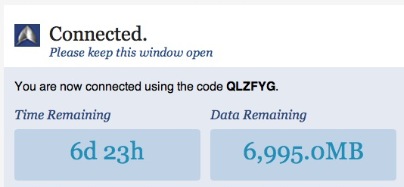
To get a sense of my frustration at the moment, consider what I am looking at right now on my screen:
The problem with his message is that 6,995.0MB is not what's remaining. That's how much I might now pay $.10/MB for, or $699.50 if I eat through the whole thing.
So, in my frustration and confusion, I just went down to the front desk, where they printed out a more readable form of this:
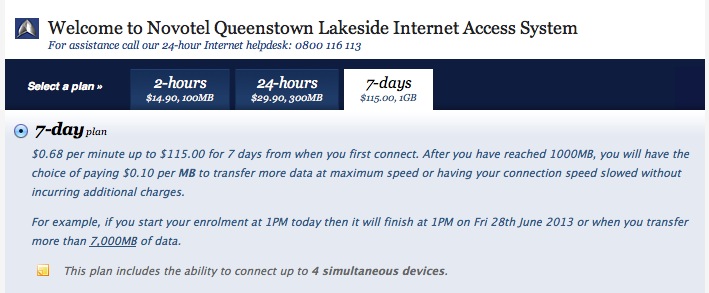
(Note: I copied this and inserted it the above later, when I had a better connection.)
Never mind the insanity of torturing customers with this strange mix of conditionalities. The market will fix that stuff eventually. (And I'll do my part with this column.) Think instead of negative vs. positive economic externalities.
On the negative side is the unlikelihood that I will ever stay in this hotel again — or in any other Accor Hotel, all of which, I gather, have the same aversive Internet offering. Also on the negative side, for the likes of Accor, is my preference these days to stay in AirBnB homes, for the simple reason that all of the ones I consider have good Internet connections, and none of them see their Internet connection as the digital equivalent of a pay toilet.
On the positive side, think about how Linux — and everything developed by geographically separated creators over the Internet — requires easily available and low-cost connections. And which then in turn produce even more products and services with positive economic externalities.
The main problem is that we're dealing with a new and awful norm here: metering the Internet as if it were a old-fashioned phone service.
While not verbatim, both the hotel and the help desk on the phone told me "all the hotels work this way." Could be that's true in New Zealand, though I doubt it. In the U.S. and Europe, the high-end hotels are the ones with expensive and inconvenient connectivity deals. It's the cheap hotels that offer free Internet, just like they offer free electricity, heat, air conditioning and running water.
In the wired parts of the Internet, where we connect by Ethernet through fiber, cable TV or phone lines, we tend not to sense prices for sums of data, even if there are "caps" involved. Comcast, for example, has "flexible" terms surrounding its 250GB/mo data caps. That's for a sum of data most of us won't use. But in the wireless parts of the Net connected over 3G and 4G/LTE connections, the "caps" start at a few hundred MB and typically go no higher than 5Gb, so they are very present and constantly threatening. (See, for example, AT&T's and Verizon's plans. Sprint, thankfully, is breaking ranks and offering unlimited data — perhaps because they learned the hard way about data caps.)
If we follow the model set by expensive hotels and mobile phone companies, the Net will turn into a complicated "service" on the model of phone and cable systems, rather than the much simpler model of pure utilities with boundless positive economic and social externalities, such as we have with electricity, water and sewage treatment. This is a huge fork in the road of the Net's future.
Back when he was Chief Scientist at BT, JP Rangaswami said the core competence of phone companies was not communications, but billing. As a group they are very successful at that. The result is what Scott Adams calls a "confusopoly": "a group of companies with similar products who intentionally confuse customers instead of competing on price". Confusopolies are shell games that make it between hard and impossible for customers to figure, or even intuit, a first cost. Nor can customers find any other source of simplicity behind the baffling choices they face in what amounts to a captive marketplace. With real utilities, that first cost can be sensed. We can see in our minds the rivers, dams, lakes, power plants, distribution wires, and sewage treatment facilities required. With roads and sidewalks we also sense the first costs, even when ordinary people provide some of the infrastructure. Utilities are utilitarian, meaning their yields are simple. We appreciate their simplicity for its pure usefulness.
The Internet should work the same way — or maybe even more simply. (Such as: we all bring our own connectivity to the market's table and build the Net out of that.) But we won't get to there as long as today's plumbing providers care more about making billing complicated than making usage simple.